
How it's made

Modern Unreal, built and tested with agents

Plain-language notes on how the game is put together, and on the pipeline that takes each change from a plan to the closed test.

Part 1 · Architecture

Built on modern Unreal Engine

From the platform at the bottom to what you see at the top. Each layer only talks to its neighbours, which keeps the game easy to extend and easy to test.

Isometric toy blocks stacked like the layers of a game engine
  1. Android XR + OpenXRThe platform: head pose, the floor, the see-through view and 26 tracked joints on each hand.Google's Android XR plugins · OpenXR
  2. Hands and gesturesProject code turns joint data into pinch, grasp, point, snap and trigger squeeze.Hysteresis · dwell · 1-euro filter
  3. Session and rulesOne persistent world and one set of rules. The server judges every outcome.Server-authoritative · listen server
  4. GAS attributesScore, combo, ammo and power charge live in one attribute set per player.Gameplay Ability System
  5. ReplicationA layout seed, batched intents and seat-relative poses travel between machines.Replication · FRandomStream
  6. MVVM + CommonUIView models feed the menus; layered screens stack cleanly over the game.Model-View-ViewModel · CommonUI
  7. PresentationHead-locked score layers, menus you can poke, captions and the star transitions.Stereo layers · world-space widgets
Server-authoritative session

One judge for every score

Solo play is a listen server with a single player, so single-player and multiplayer run exactly the same code path. The server validates every reported outcome and is the only writer of scores.

  • One persistent world: rounds stream in as level instances, and one game mode lasts the whole session.
  • Each mini-game is a data asset plus a ruleset, so a new game plugs in without framework changes.
Gameplay Ability System

Predict the feel, authorise the result

Each player’s UAbilitySystemComponent lives on their APlayerState, with the replication mode set to Mixed.

  • One attribute set carries Score, Combo multiplier, Assist strength, Ammo, Lives, Outs, Shot clock and Power charge, all replicated with change notifications.
  • The client predicts the feel (the charge, the cue). The server authorises the consequence. A predicted effect never writes Score.
Replication

Same board everywhere, from one number

The server replicates a layout seed, not the spawned objects. Every machine rebuilds the same board from it with FRandomStream.

  • Input travels as batched “intents” every 100 ms (up to 8 per batch, with a client rate limit below the server’s), not one RPC per action.
  • Head and hands are sent at 10-15 Hz, quantised and seat-relative: in each player’s own play space, never world coordinates, and never full skeletal data.
  • Disconnected players rejoin at a round boundary. Lobby and match state, shot gates and arenas are mirrored to each client explicitly.
MVVM and CommonUI

Menus that follow the data

Unreal’s Model-View-ViewModel plugin drives the menus: a navigation view model with about 19 bindable fields, with bindings authored from data files, plus a physics-tuning view model.

  • CommonUI layer stacks: Game, GameMenu, Menu and Modal.
  • Enhanced Input with a single set of mapping contexts.
Android XR and OpenXR

Hands first, on an open standard

Google’s Android XR Unreal plugins on OpenXR (pinned loader 1.1.61). Hand tracking reads all 26 joints of each hand.

  • Gestures are recognised by project code from joint data, with hysteresis, dwell, refractory periods and a 1-euro filter, never from vendor grip values.
  • The tracking origin is the local floor; the passthrough blend mode is chosen at runtime; XR features wait for permissions.
  • Read-only UI is drawn as stereo layers. The mobile forward renderer runs with MSAA 4x and multiview.
  • Additive-display art rules: nothing black or dark, a luminance floor on every material, because black is transparent.
Online-ready

Built for online play

Today’s builds play over the local network, through Unreal’s Online Subsystem (Null) with room codes. Online play is planned for a future release.

  • The server-authoritative, seed-replicated, seat-relative design is what online play needs.
  • Windows-hosted servers have already hosted real devices over the local network.

Part 2 · Testing

Built and tested with agents

AI agents write the code, build it and play it under scripts; a person plays it for real. A stage runner runs every attempt as numbered stages (build the editor, build the game, tests, smokes, package, assets), takes a build lock and writes a machine-readable result and logs.

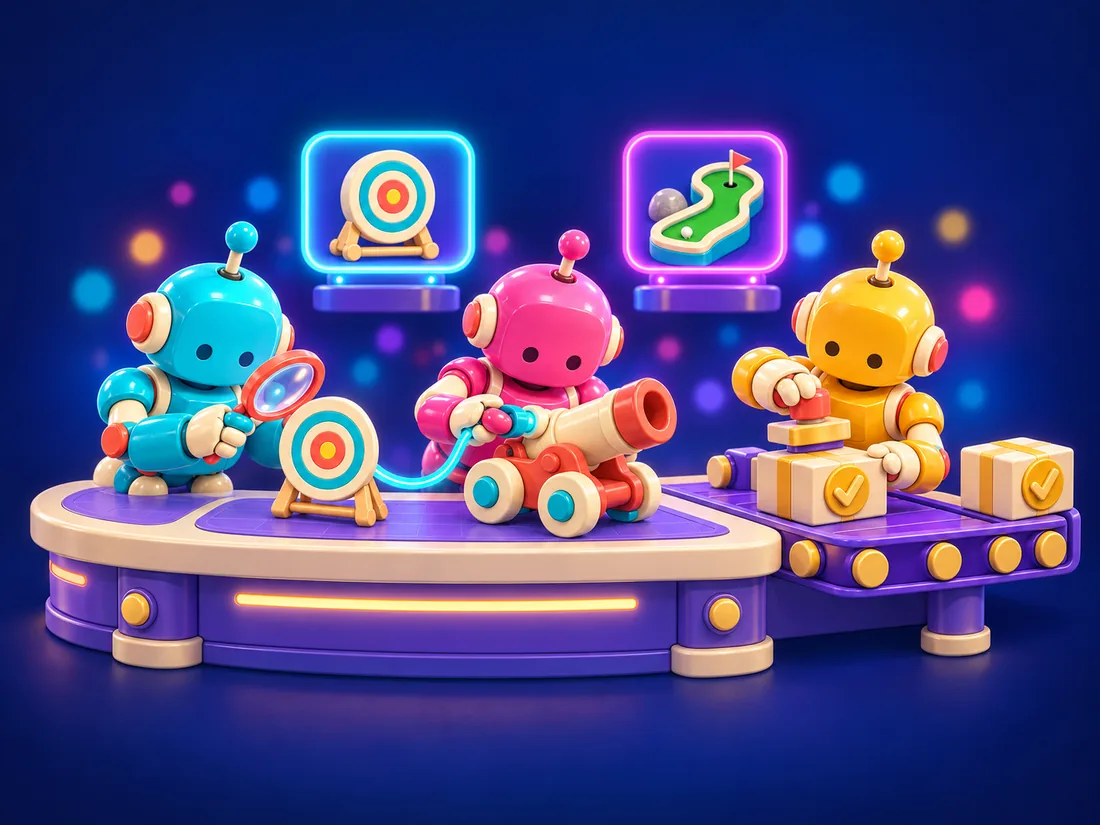
Friendly robots at a test bench, checking a toy game

The team

  • Claude Code

    Anthropic

    Writes the native C++, runs the builds and the automated tests.

  • Codex: Astra and Sol

    OpenAI

    Drive art, UI, content and independent QA.

  • ChatGPT and GPT Image

    OpenAI

    Make the 2D art: icons, posters, concept boards.

  • A human player

    Karey DevLabs

    Plays the game, judges the fun and owns the store console.

From plan to closed test

  1. PlanNumbered work items with a review.
  2. Parallel agentsEach agent works on its own files.
  3. Lock and buildOne integrator takes the build lock.
  4. 339 automated testsHeadless, on every attempt.
  5. Scripted desktop smokesThe real game plays itself and takes captures.
  6. Visual reviewAgents and people read the captures.
  7. Package + 16 KiB alignmentReady for Android 15+ page sizes.
  8. Device smokeSkips if someone is wearing the device.
  9. Hash-verified installThe installed SHA-256 must match the build.
  10. Store bundle gatesShipping build, bundle checks, size limits.
  11. Closed testReal players on Google Play.
  • 339/339automation tests passing, headless
  • ~80 MBbase module, under Google Play’s 500 MB limit
  • ~404 MBinstall-time asset pack (Play Asset Delivery)
  • ~1 dayfrom the alpha.3 plan to store submission

Why it is fast

  • Every attempt is numbered and reproducible, and leaves a machine-readable result plus its logs.
  • The same script format runs on the desktop and on the device.
  • Locks stop agents colliding: the stage runner refuses to start while the editor or another build holds the machine.
  • Visual review catches what logs miss.
  • The alpha.3 plan (six work items: snap, transitions, the drone controller, Marble Links fixes, the new cannon and a review) went from plan to store submission in about a day.

What a smoke run looks like

A scripted timeline runs console commands at set times, on phase changes or on a repeat, plays the real game windowed with a set head height, presses menus, simulates hand poses and grabs, and captures the head view at each step. The device runs the same format after checking that it is awake, not being worn and not running the app.

Illustrative example
smoke-timeline (illustrative)
# Illustrative: a short desktop smoke timeline
at 2.0 party.UI.Press play.archery
on-phase Lobby party.UI.Press start
at 12.0 party.Hands.SimGrab Bow grab
every 5.0 party.Validate.HeadCapture archery-round
on-phase Results party.Validate.HeadCapture archery-results
quit-at 120

Lessons we learned

The 403 on the very last chunk

Google Play answered a 760 MB upload with an HTTP 403 on the final chunk. The real reason was the 500 MB limit on the base module. Moving the game data into an install-time asset pack fixed it: about 80 MB of base plus about 404 MB of pack.

A black capture proves nothing

A screenshot from the device came back black while the game was running fine: the compositor draws somewhere a screenshot cannot see. So the team captures a head view from inside the game itself.

Black is transparent

A see-through display adds light; it cannot draw black. A fade to black would simply vanish, so scene changes use a glowing star instead, and no material is allowed to be dark.

Curious about the tools? See the credits, or join the closed test and try the result.